
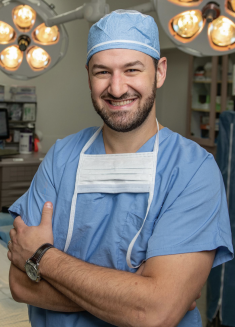
 Thirteen years of complications ended with a three-centimeter robotic incision for “Bob,” now 51 years old, thanks to urologists with the Rutgers New Jersey Medical School. In 2011, a gunshot to his abdomen required major surgery at another institution. The bullet sliced his ureter, which transports urine from the kidney to the bladder. To help it heal properly, doctors inserted a stent, a plastic device typically deployed for three to six months.
Forgotten, the stent became encrusted, which required more invasive procedures, culminating in 10-centimeter long-scar that caused severe narrowing of three-quarters of Bob’s ureter. Without repair, Bob would require a lifelong tube in his back to drain his kidney, which is very uncomfortable and could lead to infections. With such a challenging scar, doctors contemplated removing the affected kidney or leaving a tube inside him permanently. Neither seemed an ideal choice for Bob.
Enter associate professors Amjad Alwaal, director of urologic reconstruction and men’s health, and Evan Kovac, director of urologic oncology and robotic surgery at Rutgers New Jersey Medical School (NJMS) and University Hospital. Together, they hoped to save the kidney, which still had good function. To read the full story.